 Products Home
Ultra-Thin Notch Filters
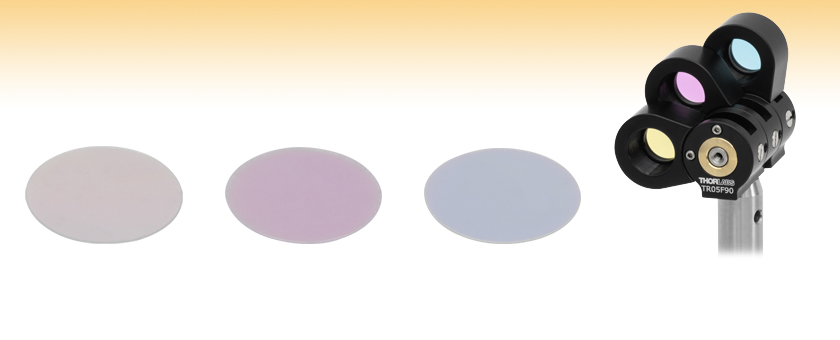
- Attenuate Light Within a Specific Wavelength Range
- Center Wavelengths from 405 nm to 1064 nm
- Ideal for Spectroscopy Applications
- Ultra-Thin Design For Compact Systems
NFU532-43
Ultra-Thin Notch Filter
CWL: 532 nm
NFU561-45
Ultra-Thin Notch Filter
CWL: 561 nm
NFU633-51
Ultra-Thin Notch Filter
CWL: 633 nm
Application Idea
NFU488-59, NFU561-45, and NFU633-51 Notch FIlters Mounted in Three TR05F90 FLip Mounts



Please Wait
| Table 1.1 Common Specifications | |
|---|---|
| Transmission in Passbands | Tavg > 85% |
| Peak Optical Density at Center Wavelength | >6 |
| Clear Aperture | ≥Ø11.3 mm (Ø0.44") |
| Thickness | <0.3 mm |
| Center Wavelength Tolerance | ≤2% of CWL |
| Substratea | PMMA/Acrylic |
| Surface Quality | 60-40 Scratch-Dig |
| Construction | Polymer Preform Heated and Pulled then Cut Into Filters |
Packaging Redesign
Thorlabs is investing in green initiatives to replace plastic and foam optics packaging with more sustainable solutions. Leave feedback or learn more about what went into the design of our pilot program for optics here.
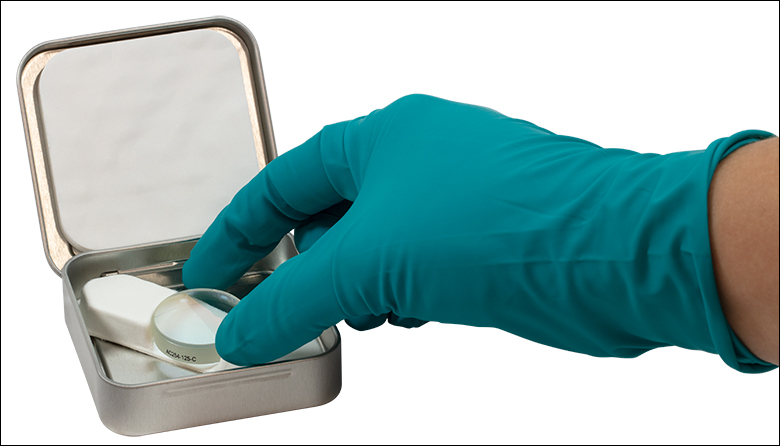
Click to Enlarge
Our new case is made from recyclable steel and includes recyclable paper inserts to protect the optic inside.

Features
- 12.5 mm Outer Diameter, <0.3 mm Thick Notch Filters
- OD > 6 at Center Wavelength
- Ultra-Thin and Lightweight Construction Ideal for Integration into Portable Devices
- Ideal as Raman Spectroscopy Filters or Emission Filters for Fluorescence Applications in Compact Systems
- Custom Filter Sizes and Shapes Available by Contacting Tech Sales
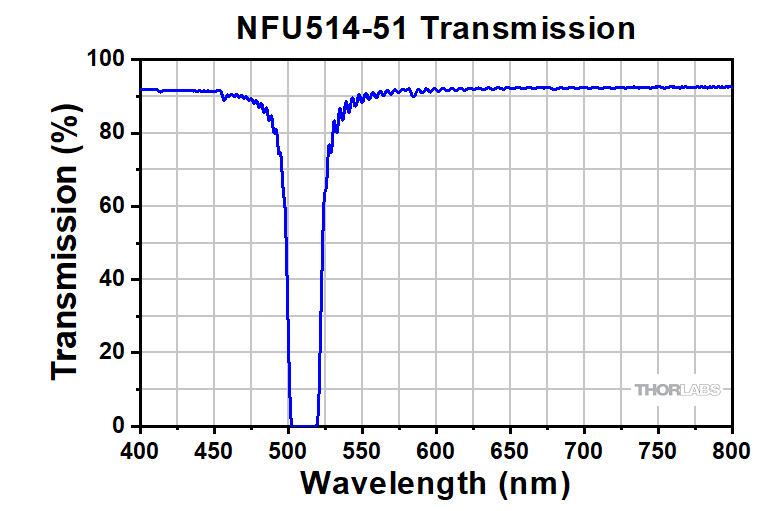
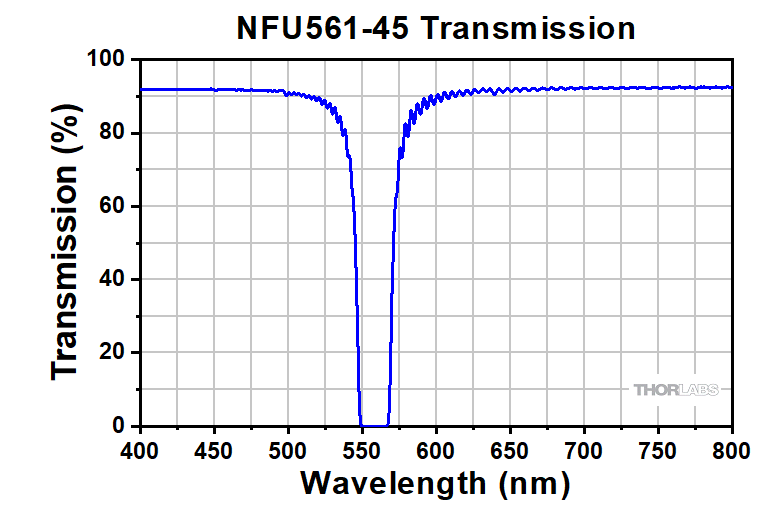
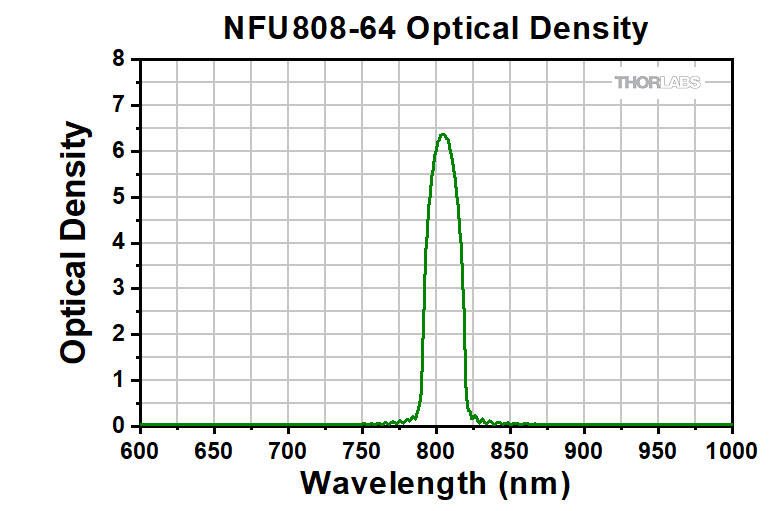
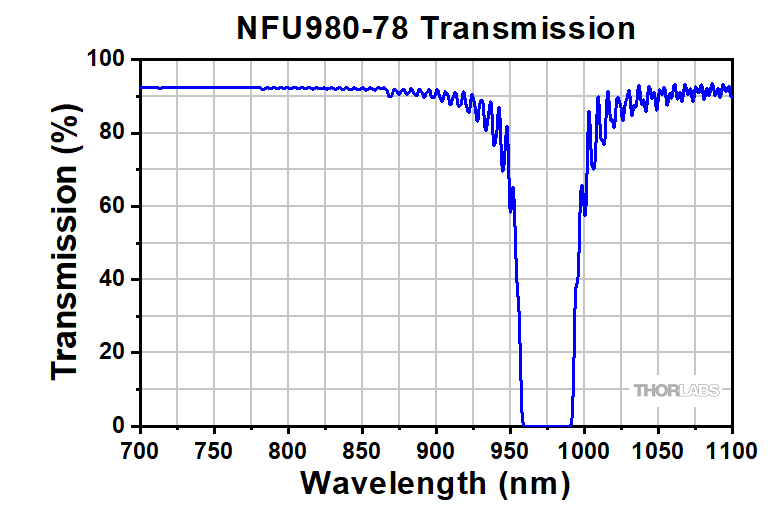
Thorlabs offers Ultra-Thin Notch Filters, also commonly referred to as band-stop or band-rejection filters, that are designed to transmit most wavelengths with little intensity loss while attenuating light within a specific wavelength range (the stop band) to a very low level. These filters, manufactured by Everix®†, offer an optical density (OD) in excess of 6 at the center wavelength and greater than 85% average transmission in the passbands. See the Transmission Graphs and OD Graphs tabs for the entire performance over the passbands and blocking region.
Notch filters are useful in applications where one needs to block light from a laser. For instance, to obtain good signal-to-noise ratios in Raman spectroscopy experiments, it is critical that light from the pump laser be blocked. This is achieved by placing a notch filter in the detection channel of the setup. In addition to spectroscopy, notch filters are commonly used in laser-based fluorescence instrumentation and biomedical laser systems.
These ultra-thin filters are primarily composed of poly(methyl methacrylate) (PMMA), also referred to as acrylic glass, which enables them to be directly bonded to other optical components with an acrylic-based optical adhesive or epoxy. This makes these ultra-thin filters ideal for applications in lightweight sensors, miniature diagnostics, and point-of-care diagnostics. Each filter comes in a mesh net for protection, and can be mounted in any SM05 component mount, such as our LMR05 fixed lens mounts, our TR05F90(/M) flip mounts, or our SCFW6 cage filter wheel. We recommend caution when mounting the filters with retaining rings, as overtightening the rings can damage the filter's external layers.
Due to their size, these optics are best handled with a pair of tweezers. From the PMMA/Acrylic polymer used in these filters, care must be taken to avoid any chemicals that are solvents for PMMA, such as acetone or methanol, as detailed in the Cleaning PMMA/Acrylic Optics section of our Optics Handling and Care Tutorial.
Click to Enlarge
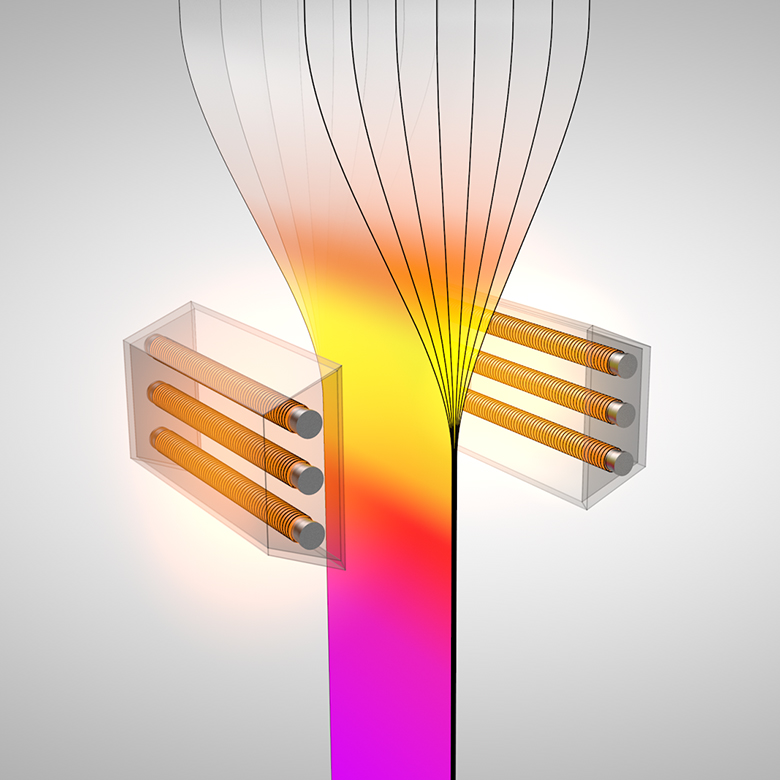
Figure 1.1 Illustration of the Construction Process for Ultra-Thin Filters
Filter Construction
These notch filters are formed from a series of very thin PMMA/Acrylic-based polymer layers which are assembled into a larger block of polymers, referred to as a preform. This preform is heated and pulled in one direction, reducing the layer thickness until the layers are thin enough to cause thin film interference between the layers of the polymers. These layers are embedded into a pair of thicker acrylic covers for resistance against scratching and chipping of the surface. The resulting thin sheet is spectrally mapped to measure spectral performance, and the filters are then cut out.
Due to this process, the filters lack a defined substrate. The typical thickness observed in our ultra-thin filters is between 0.1 to 0.3 mm, roughly 6 to 20 times thinner than the ≥2.0 mm substrates used to form Thorlabs' dielectric stack notch filters. These ultra-thin filters are slightly bendable and can be 3-D formed to reduce or eliminate angle-of-incident effects on the spectrum. If your application requires a particular bending curvature, please reach out to Tech Sales to inquire about custom options.
†Everix is a registered trademark of Everix Optical Filters.
Below are transmission plots for our ultra-thin notch filters, obtained at normal incidence. Although designed for use at normal incidence, the performance of these filters will not vary significantly if used within an AOI of ±3°, but the performance may differ slightly from that shown here. Please note that the measured data presented is typical, and performance may vary from lot to lot, especially outside of the specified wavelength range of each filter.
Our 532 nm filter (NFU532-43) has a plot of the transmission as a function of the angle of incidence; this plot can be used as an example of how the center wavelength varies with AOI.
Plots of the optical density in the blocking region and spectra vs. AOI may be found in the OD Graphs and AOI Graphs tabs, respectively.
The plots below detail the optical density in the blocking region of our ultra-thin notch filters. Please note that the measured data presented is typical, and performance may vary from lot to lot, especially outside of the specified wavelength range of each filter.
Plots of the transmission vs. wavelength and spectra vs. AOI may be found in the Transmission Graphs and AOI Graphs tabs, respectively.
Optical Density (OD) is related to transmission by the following relationship:

Dependence of Center Wavelength (CWL) on Angle of Incidence (AOI)
Thorlabs' ultra-thin filters are intended to be used with collimated light normally incident on the surface of the filter. For uncollimated light or light striking the surface at an angle, the center wavelength (CWL) will shift towards the UV end of the spectrum and the shape of the transmission region (passband) will change. Measurements of the filter transmission were made at different angles of incidence (AOI) and were taken using the same spectrophotometer used to make the on-axis measurements shown in the transmission graphs in Table G1.1. Data was collected for both s- and p-polarized states with transmission plots for a select notch filter obtained at an AOI of 0°, 15°, 30°, and 45° shown below in Figure 4.1. Figure 4.2 shows a more narrow view of the CWL displaying a dependence on the AOI obtained at 5° increments from 0° to 20°.

Click to Enlarge
Figure 4.1 Plot showing the transmission of an NFU532-43 notch filter at different angles of incidence for s- and p-polarized light. Click here for raw data.

Click to Enlarge
Figure 4.2 Plot showing the center wavelength of an NFU532-43 notch filter at different angles of incidence. Click here for raw data.
Please note: All measured data presented is an example of the performance of our notch filters. Performance will vary from filter to filter, especially at off-axis angles of incidence. Plots of transmission and optical density for all filters may be found in the Transmission Graphs and OD Graphs tabs respectively.
Ultra-Thin Filter Differences
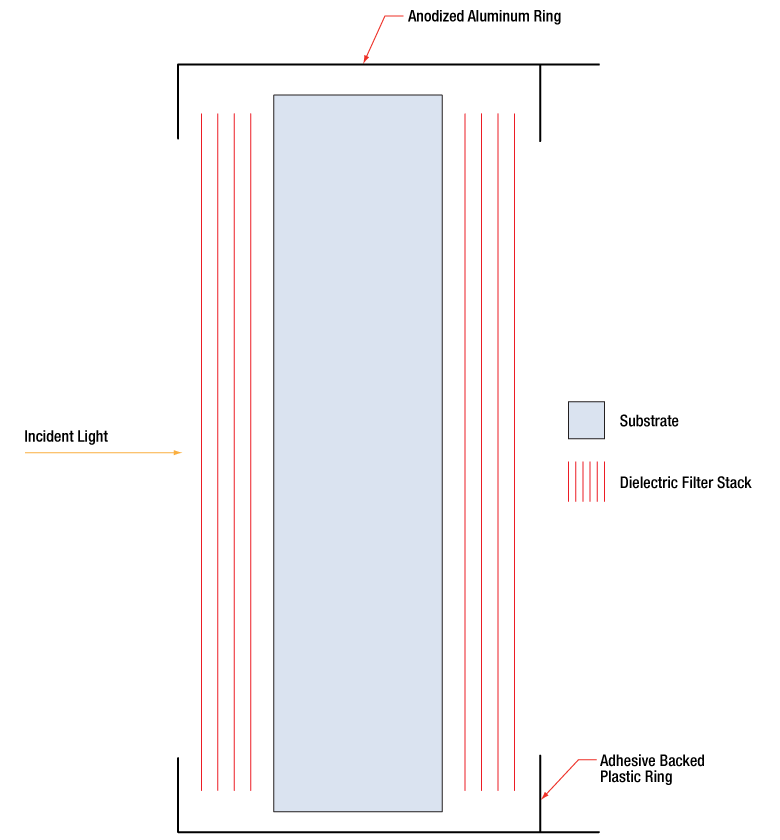
Hard-Coated Filter Structure
 Click to Enlarge
Figure 5.1 A hard-coated bandpass filter is deposited onto the substrate surfaces. The number of layers shown in this schematic is not indicative of the number of layers in an actual hard-coated bandpass filter. The drawing is also not to scale.
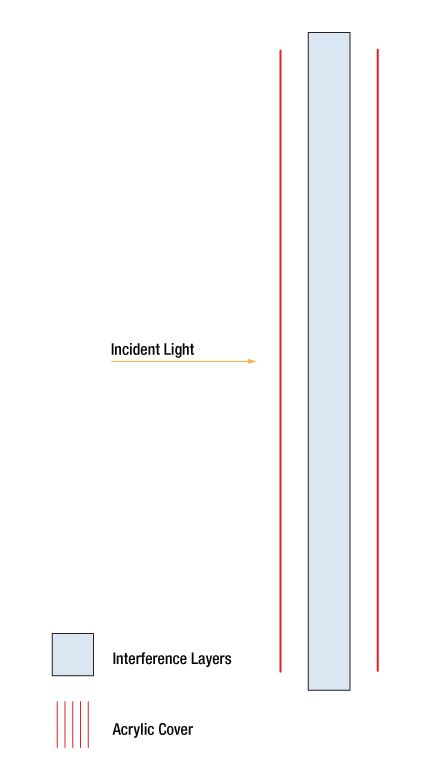
Ultra-Thin Filter Structure
 Click to Enlarge
Figure 5.2 An ultra-thin filter is formed from a polymer preform made of hundreds of layers thermally drawn into a thin sheet. Thicker acrylic layers cover the exterior to protect from chipping and breakage. The number of layers shown in this schematic is not indicative of the number of layers in an actual ultra-thin notch filter. The drawing is also not shown to scale.
Ultra-thin filters are a new, alternative type of filter to our traditional hard-coated optical filters. Hard-coated filters offer very high durability and transmission performance, and are useful with high-powered optical systems. These ultra-thin filters compromise some optical performance in exchange for an extremely compact design that is useful for integration into smaller systems and enable new applications.
Hard-coated filters are produced by sputtering dielectric layers onto a glass substrate, such as UV fused silica; the dielectric coatings are very durable and can be exposed to the environment without degradation of performance. The film construction is essentially a modified quarter-wave stack, using interference effects to isolate spectral bands. The dense coating on these filters allows them to be constructed using a single substrate, as shown in Figure 5.1, which yields a stable, long-lasting, and high-quality optical filter. This process is automated and results in a transmitted wavefront error value that is close to that of an uncoated optic.
Ultra-thin filters are constructed differently, not using sputtering or physical vapor deposition but formed from a series of very thin PMMA/Acrylic-based polymer layers which are assembled into a larger block of polymers, referred to as a preform. This preform is heated and pulled in one direction, reducing the layer thickness further until the layers are thin enough to cause thin film interference. These interference layers are embedded into a pair of thicker acrylic covers for resistance against scratching and chipping of the surface, as shown in Figure 5.2. The resulting thin sheet is spectrally mapped to measure spectral performance, and the filters are then cut out.
Due to this method of construction, the filters lack a substrate and observe a typical thickness between 0.1 and 0.3 mm, roughly 6 to 20 times thinner than the ≥2.0 mm substrates used to form Thorlabs' dielectric stack notch filters. The filters are also slightly bendable and can be 3-D formed to reduce or eliminate angle-of-incidence effects on the spectrum. The acrylic material of the ultra-thin filters means that changes in heat and humidity above the softening point of PMMA, roughly 110 - 115 °C, can induce small thickness changes in the polymer layers. These changes in layer thickness can lead to adverse alterations to spectral performance that are possibly permanent, so we recommend storing the filters in environments below ~90 °C.
The performance of our ultra-thin notch filters is slightly lower than that of our dielectric stack notch filters, with average transmissions above 85% in their transmission region and an OD above 6 achieved in their rejection region. As can be seen in Figures 5.3 and 5.4, the performance is comparable across the rejection region of the filters, with the ultra-thin filters even exceeding the optical density achieved by the dielectric stack filters. In return, the dielectric stack filters have a much steeper slope at the edges of the passband compared to the ultra-thin filters, and show a flatter transmission evident of the high precision and repeatability of the sputtering process used to make them.
 Click to Enlarge
Figure 5.4 Performance Comparison of Optical Density of
Dielectric Stack and Ultra-Thin Notch Filters
 Click to Enlarge
Figure 5.3 Performance Comparison of Transmission of
Dielectric Stack and Ultra-Thin Notch Filters
| Posted Comments: | |
| No Comments Posted |

| Table G1.1 Specifications | ||||||
|---|---|---|---|---|---|---|
| Item # | Center Wavelength (CWL) |
FWHMa of Blocking Region at CWL (Max) |
Passbands (Tavg > 85%) |
Transmission Graphb |
OD Graphc |
AOI Graphsd |
| NFU405-49 | 405 ± 8.1 nm | 48.6 nm | 435.4 - 1200 nme |  |
 |
- |
| NFU488-59 | 488 ± 9.8 nm | 58.6 nm | 400 - 451.4 nm 524.6 - 1200 nm |
 |
 |
- |
| NFU514-51 | 514 ± 10.3 nm | 51.4 nm | 400 - 480.6 nm 547.5 - 1200 nm |
 |
 |
- |
| NFU532-43 | 532 ± 10.7 nm | 42.6 nm | 400 - 502.7 nm 561.3 - 1200 nm |
 |
 |
|
| NFU561-45 | 561 ± 11.3 nm | 44.9 nm | 400 - 530.1 nm 591.9 - 1200 nm |
 |
 |
- |
| NFU594-48 | 594 ± 11.9 nm | 47.6 nm | 400 - 561.3 nm 626.7 - 1200 nm |
 |
 |
- |
| NFU633-51 | 633 ± 12.7 nm | 50.7 nm | 400 - 598.1 nm 667.9 - 1200 nm |
 |
 |
- |
| NFU658-53 | 658 ± 13.2 nm | 52.7 nm | 400 - 621.9 nm 694.2 - 1200 nm |
 |
 |
- |
| NFU785-63 | 785 ± 15.7 nm | 62.8 nm | 425 - 741.8 nm 828.2 - 1200 nm |
 |
 |
- |
| NFU808-64 | 808 ± 16.2 nm | 64.6 nm | 450 - 763.6 nm 852.4 - 1200 nm |
 |
 |
- |
| NFU980-78 | 980 ± 19.6 nm | 78.4 nm | 414 - 926.1 nm 1033.9 - 1200 nm |
 |
 |
- |
| NFU1030-82 | 1030 ± 20.6 nm | 82.4 nm | 600 - 973.3 nm 1086.7 - 1300 nm |
 |
 |
- |
| NFU1064-85 | 1064 ± 21.3 nm | 85.2 nm | 600 - 1005.5 nm 1122.6 - 1300 nm |
 |
 |
- |
 Ultra-Thin Notch Filters